
Last updated August 25, 2026
Free visual inspection and a written scope of work before any mitigation begins - photos, moisture readings, and drying logs go in your claim file
The scope we write is the scope we bill. Anything new gets shown to you, in writing, before we touch it.




 Before
 After
After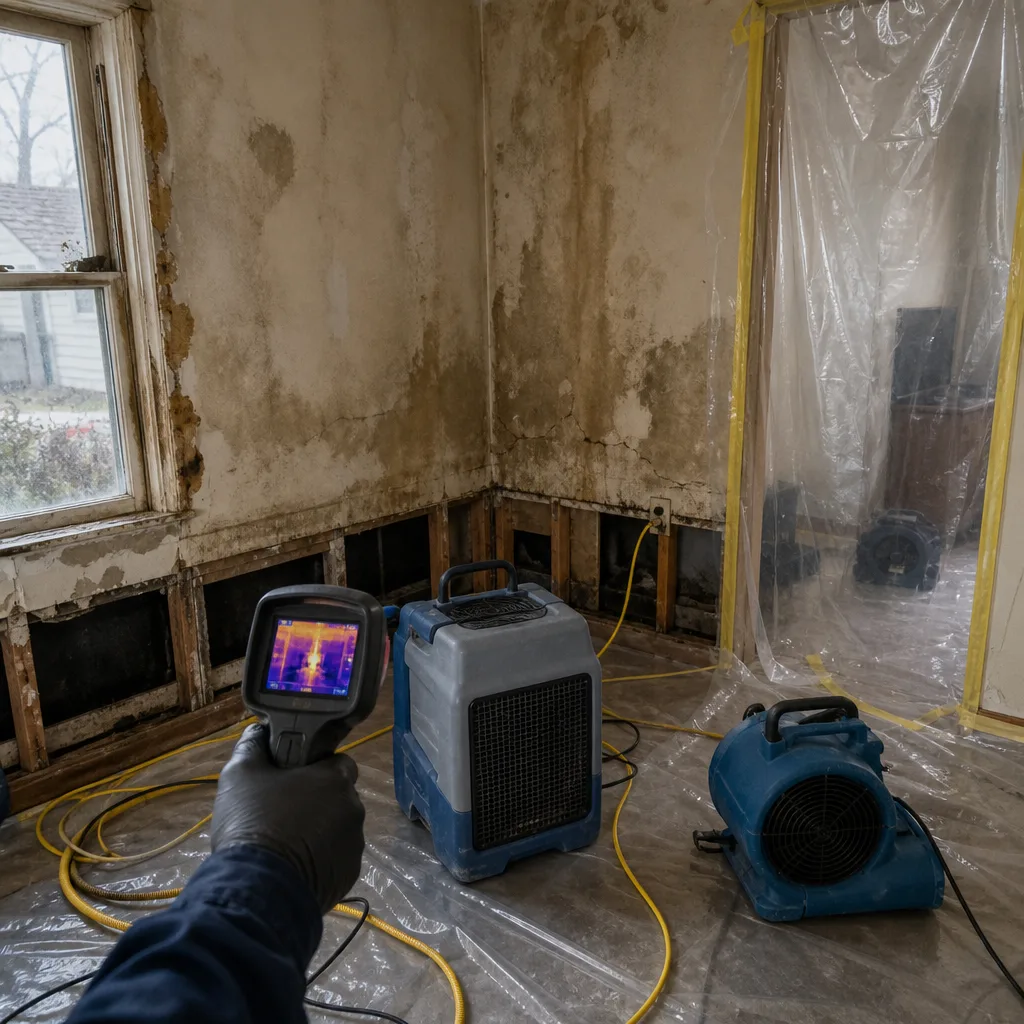 Before
 After
After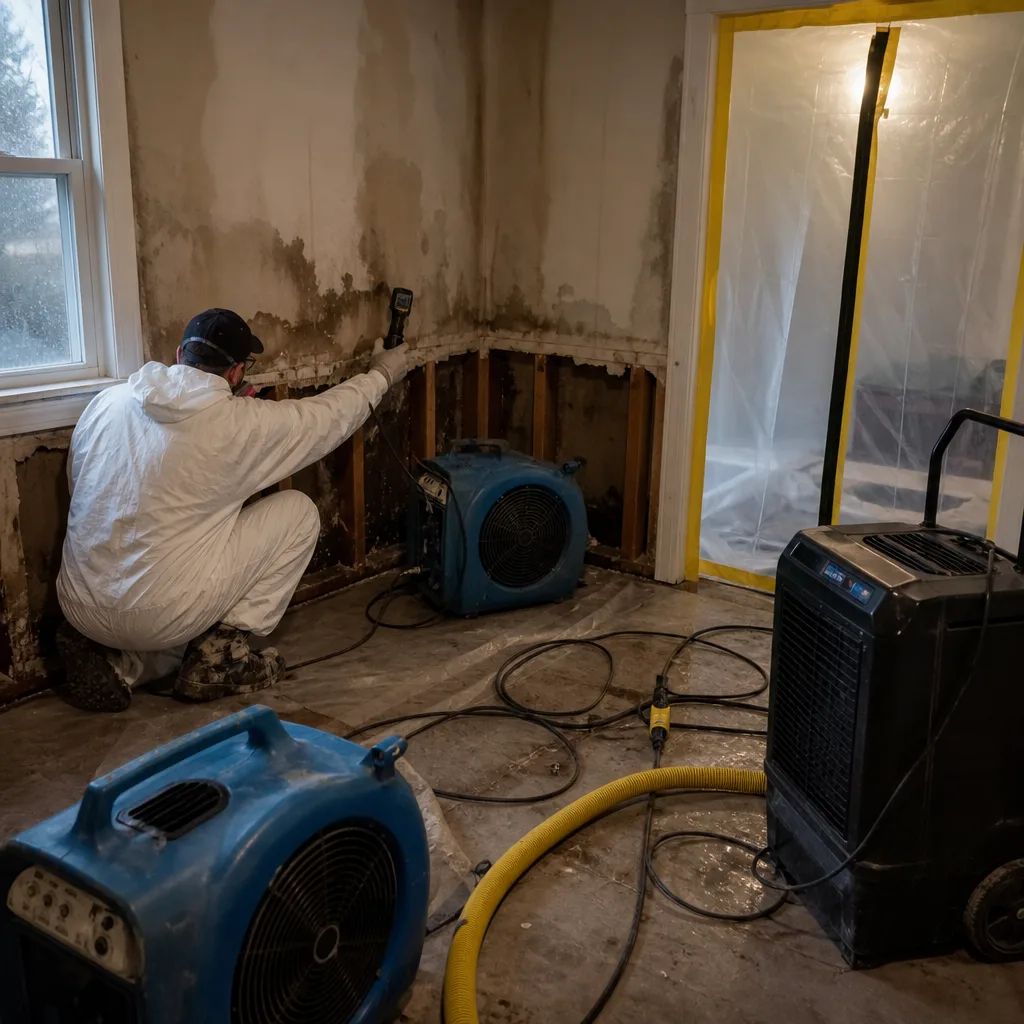 Before
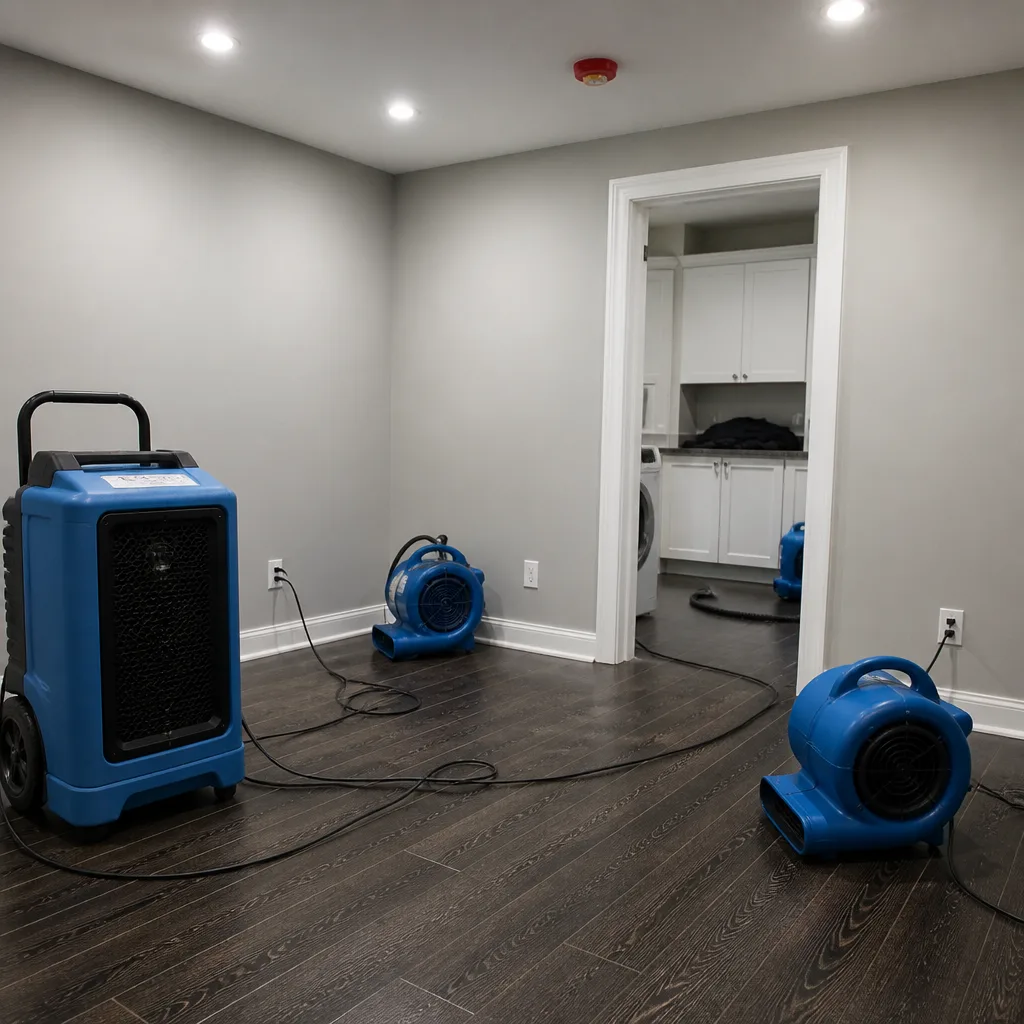 After
AfterHow to Hire a Damage Restoration Contractor in Kearny: A Step-by-Step Guide
Most homeowners in Kearny will hire a restoration contractor exactly once in their lives, and they’ll do it during the worst week they’ve had in years. A pipe lets go at 1 a.m., a summer storm pushes the Passaic over its banks, or a kitchen fire leaves half the house standing and the other half coated in soot. The contractor you choose in that first panicked hour determines whether you’re back in your home in three weeks or stuck in a hotel for three months. This guide walks through the hiring process step by step: what to check before you sign, the questions that expose a weak contractor, how insurance really works in these jobs, and what separates a company that finishes the job from one that disappears after the check clears. We’ve worked in Kearny long enough to know how this goes wrong, and how to get it right.
Floodline Restoration Co. home
Quick Answer
Hire a damage restoration contractor in Kearny by checking three things before anything else: they answer the phone with a live person 24/7, they hold IICRC certification and carry proper insurance, and they put their guarantee in writing before work starts. The contractor should handle insurance billing directly, provide a written scope of work with moisture readings logged daily, and stay on the job from extraction through rebuild. In Kearny’s older housing stock, speed matters - water moves through plaster and balloon framing fast, so a same-visit extraction is worth more than the lowest bid.
Table of Contents
- Understand Your Damage Before You Dial
- Vet the Contractor: Credentials, Insurance, and Track Record
- Get the Scope in Writing Before Work Starts
- Insurance: Who Talks to the Adjuster, and How Billing Works
- Why Equipment Brands and Moisture Logs Matter
- Red Flags That End a Contractor Interview Fast
- What Kearny Homeowners Need to Know: Climate, Codes, and Old Houses
- Common Mistakes to Avoid
Understand Your Damage Before You Dial
Before you call anyone, take ten minutes to figure out what kind of damage you’re actually dealing with. This determines who you call, how fast they need to move, and whether you’re looking at a cleanup job or a full rebuild. Walk the house. Look at the walls, the floors, the ceiling. Take photos with your phone from multiple angles. The photos matter later for insurance.
Water damage breaks down into three categories, and they are not equal. Clean water comes from a supply line or a failed water heater. Gray water carries some contamination - think washing machine overflow or sump pump discharge. Black water is sewage, river floodwater from the Passaic, or any standing water that’s been sitting long enough to grow bacteria. If you’re dealing with black water in a Kearny basement, you don’t want to be down there without proper protective gear. That’s a job for a trained crew, not a wet-dry vac.
Fire damage has its own logic. The flames destroy some things, but the smoke and soot travel further than you’d think, and the water the fire department used causes secondary damage that shows up days later. Mold is different still: it’s a moisture problem first and a cleanup problem second. If you don’t fix the moisture source, the mold comes back no matter how well it’s cleaned. Any contractor who promises mold remediation without finding and fixing the water source is selling you half a job.
Understanding your damage type helps you ask the right questions and spot a contractor who’s stretching the truth. It also tells you how urgent the situation is. A slow drip under a Kearny kitchen sink can wait until morning. Two inches of Passaic floodwater in a finished basement cannot.
Vet the Contractor: Credentials, Insurance, and Track Record
The first call is where most people make their mistake. They call the first number that pops up on Google, or the one a neighbor’s cousin recommended. There’s nothing wrong with fast action - in a water damage situation, fast action is the whole game. But you can move fast and still vet properly. Here’s the checklist, in order.
- Does a live person answer? Call at an odd hour if you want a real test. A restoration contractor serving Kearny should have live dispatch around the clock, every day. If you get a recording at 2 a.m. when your basement is filling with water, you’ve learned something important about that company.
- Are they certified? Ask about IICRC certification. The Institute of Inspection, Cleaning and Restoration Certification is the industry standard for water damage, fire damage, and mold work. A company that trains its technicians to IICRC standards has invested in doing this properly. RIA and IFA certifications matter too, but IICRC is the one most insurance carriers recognize.
- Are they insured and can they prove it? Get the certificate of insurance. Not just liability - ask about workers’ comp. If one of their crew gets hurt in your house and the company doesn’t carry workers’ comp, that problem can land on your homeowner’s policy.
- How long have they been local? A company that’s served the same area for years has a reputation to protect. They know Kearny’s housing stock, the common failure points in older homes, and which streets flood when the river rises. They also plan to be around if something goes wrong after the job.
- Are technicians background-checked and uniformed? You’re letting strangers into your home during one of the most stressful weeks of your life. You deserve to know who’s walking through the door. A company that runs background checks and sends uniformed, identifiable technicians is telling you something about how they operate.
We’ve been doing this in Kearny since 2010, and we’ve seen what happens when homeowners skip this step. The cheapest bid often comes from someone without the insurance, certification, or local accountability to back it up. That bid gets expensive fast.
Get the Scope in Writing Before Work Starts
This is the step that separates a square deal from an expensive lesson. A written scope of work is a document that describes exactly what the contractor will do, what materials they’ll use, what it will cost, and how long it will take. If a contractor won’t put the scope in writing before starting, walk away. It’s that simple.
Why does this matter so much? Because damage restoration has a known reputation problem. It’s the trade where the quote comes in low, the crew finds “unexpected issues” on day two, and the final bill lands at twice the estimate. A written scope agreed before work starts protects you from that. It doesn’t mean the price can’t change - hidden damage does get discovered - but it means a change requires a conversation and your sign-off, not a surprise on the final invoice.
Here’s what a proper scope should include:
- Moisture map and readings: For water damage, the contractor should document initial moisture levels in every affected area and commit to daily readings until the structure hits the dry standard. You should get that log, in your hands, during and after the job.
- Equipment list: What machines are being deployed, where, and for how long. Professional-grade equipment matters - more on that below.
- Demolition boundaries: Which walls, floors, and ceilings are coming out, and which are being saved. This is where scope creep lives.
- Rebuild specifications: If the job includes reconstruction, what materials will be used, what finishes, what timeline.
- Insurance billing terms: Who bills the carrier directly, how the deductible is handled, and what happens if the adjuster disputes a line item.
- Guarantee terms: What’s covered, for how long, and what triggers the guarantee. If the guarantee is verbal, it doesn’t exist.
Our company backs every job with a written 90-Day Done Right Promise. It’s called the Keystone Standard internally, and it means exactly what it sounds like: if it’s not done right, we make it right. No paperwork battles. No arguing. It’s in writing from day one, tied to a values code we call K.E.Y.S.: Krafted right, Every time, Your home first, Standing behind it.
Insurance: Who Talks to the Adjuster, and How Billing Works
Here’s how insurance restoration actually works, because nobody explains this until you’re standing in a wet living room.
You file a claim. An adjuster comes out, assesses the damage, and approves a payout based on what they see. The restoration contractor does the work and bills the carrier. In a well-run job, you never play messenger between the contractor and the insurance company. The contractor documents everything, sends photos and moisture logs to the adjuster, and handles the billing directly.
The problem comes when a contractor doesn’t document properly. The adjuster disputes a charge. The contractor comes to you asking for more money. You’re now in the middle, trying to explain why a piece of equipment ran for six days instead of four. That’s the moment homeowners hate most, and it’s avoidable if the contractor runs a tight documentation process from day one.
Ask the contractor these questions before signing:
- “Do you bill my insurance carrier directly?” If the answer is no, keep looking.
- “Do you provide photo documentation and daily moisture readings to the adjuster?” If the answer is anything less than yes, keep looking.
- “What happens if the adjuster disputes a line item?” The right answer is: “That’s between us and the carrier. Your price doesn’t change.”
- “How is my deductible handled?” You pay the deductible. Everything above that is between the contractor and the carrier. Get that in writing.
Kearny homeowners deal with everything from minor sump pump failures to full Passaic River flood claims, and the insurance companies are just as particular about documentation in a $4,000 cleanup as they are in a $90,000 flood loss. A contractor who runs a tight documentation process makes your claim smoother regardless of size.
Why Equipment Brands and Moisture Logs Matter
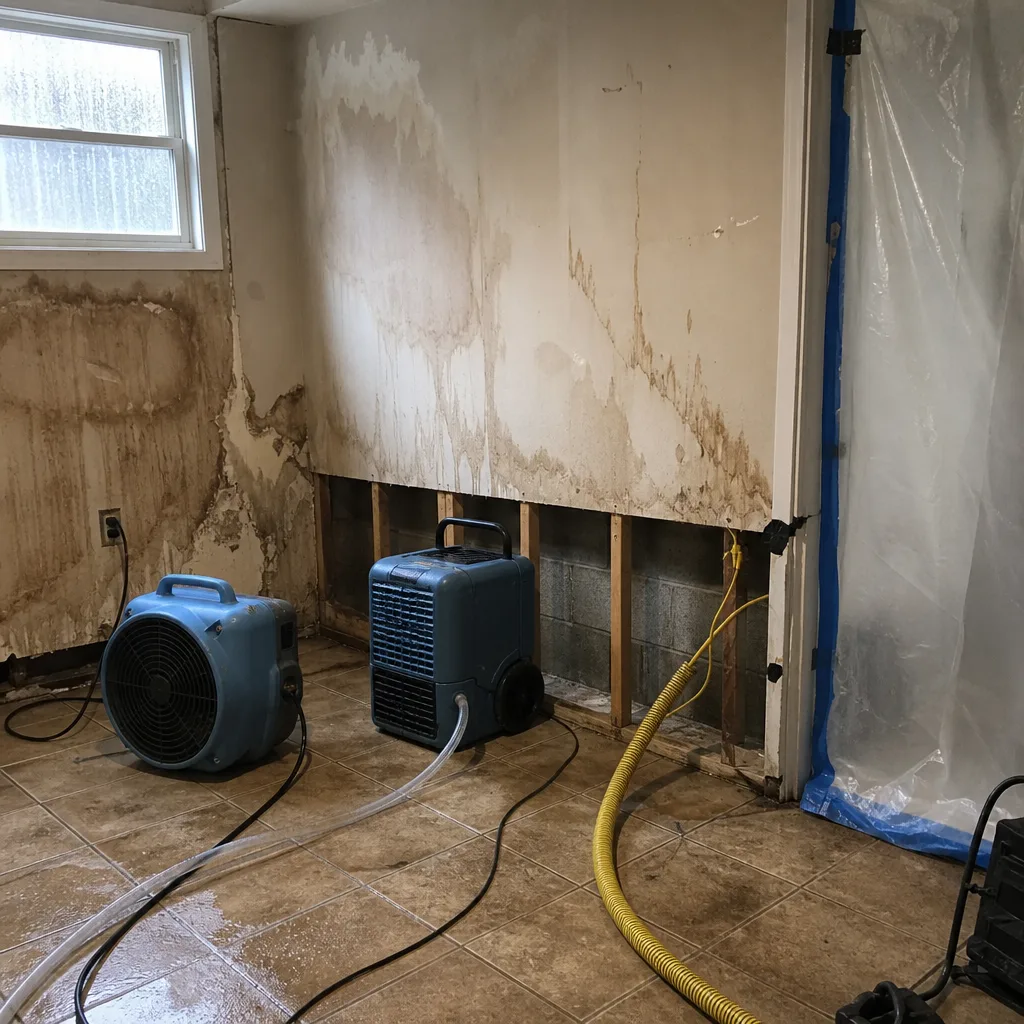
Most homeowners never think about the machines a restoration company uses. That’s a mistake, because the equipment determines whether the job actually works. Here’s the truth: a wet wall that isn’t dried thoroughly will mold inside the cavity, and you won’t see it for months. The way you dry a wall thoroughly is with professional-grade equipment and daily moisture readings.
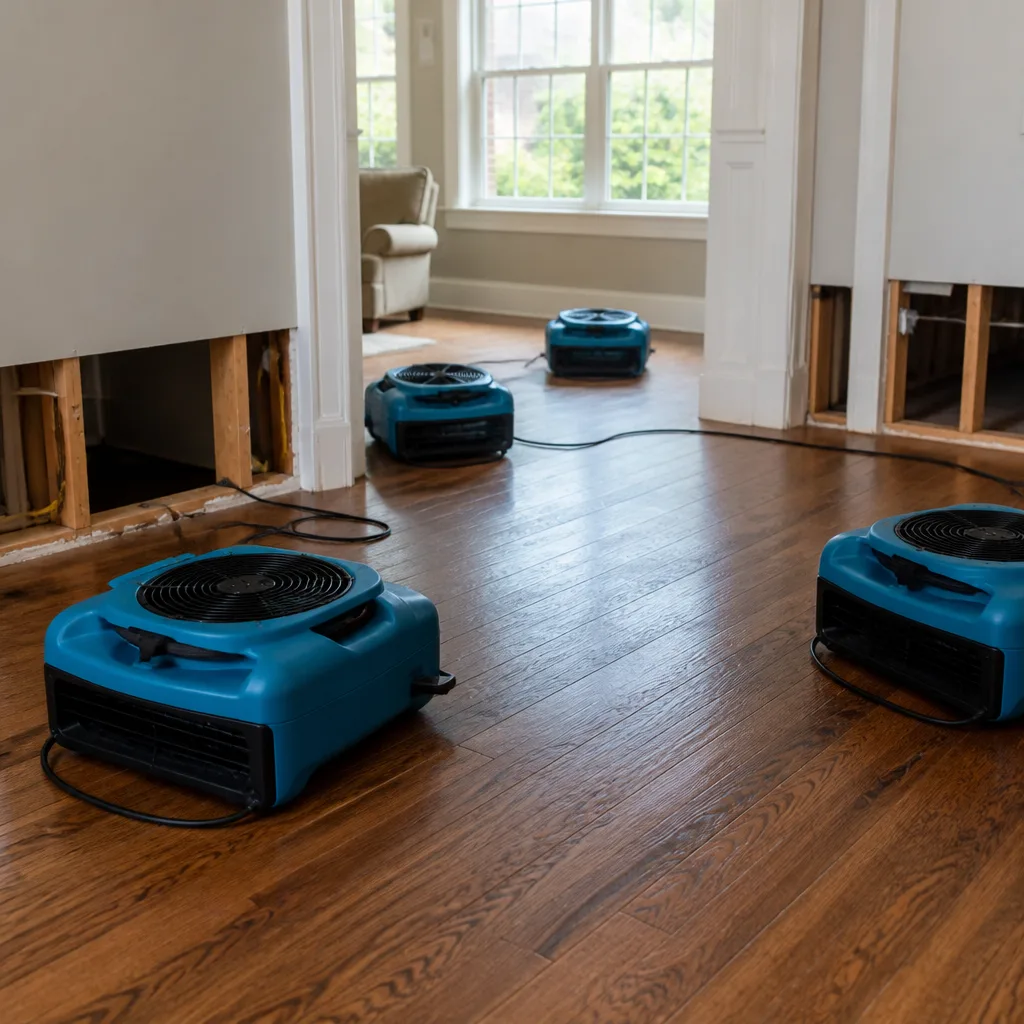
We run Dri-Eaz dehumidifiers, Phoenix air movers, XPOWER fans, B-Air drying systems, and Injectidry injection drying for wall cavities and under floors. These aren’t the machines you rent from a hardware store. They move more air, pull more water, and run at the right temperature and humidity to dry building materials without causing secondary damage. A restoration company running homeowner-grade equipment is guessing, and you’re paying for the guess.
Just as important as the equipment is the moisture log. Water moves through plaster, drywall, and wood framing in ways that aren’t visible from the surface. A wall can feel dry to the touch and still be holding 30% moisture content inside. The dry standard - the point at which building materials are dry enough to prevent mold growth - is typically around 15% moisture content for wood, depending on the material. Getting there requires daily readings with a moisture meter, and the readings need to be logged and shared with you and your insurance carrier.
Here’s what to ask: “Will I receive a moisture log with daily readings from day one until the dry standard is met?” If the contractor hesitates, that’s your answer. A company that reads the moisture map on day one and hands you the completed log at the end is doing the job properly. The same crew should handle daily readings throughout the job - not a different subcontractor every day - and the rebuild crew should be the same people who did the extraction and drying. Handoffs are where details get lost.
Red Flags That End a Contractor Interview Fast
You can usually spot a bad restoration contractor within the first phone call if you know what to listen for. Here’s what ends an interview for us, and what should end it for you.
- No written estimate before work starts. A verbal quote is not an estimate. It’s a guess, and you’ll pay for the guessing.
- Asking for full payment upfront. Deposits are normal in reconstruction work. Full payment before extraction is not. A contractor who needs 100% upfront is either broke or planning to disappear.
- No insurance or dodging the certificate of insurance. This is the fastest disqualifier. If they can’t produce a certificate in an hour, they’re not insured, or they’re hiding something.
- Subcontracting the entire job. Some contractors are really just middlemen who hand your house to another crew and mark up the bill. Ask directly: “Is your crew doing this work, or are you subbing it out?”
- Promising mold removal without moisture source fix. Mold is a symptom of water. Remove the mold but leave the water, and you’ve bought yourself a few months of clean walls. When the mold returns, the contractor is gone.
- Pressure to sign immediately. A good contractor wants you to move fast, because speed matters in water damage. But they should never pressure you to skip the written scope or sign something you haven’t read. Fast is different from rushed.
In our experience, the worst stories from Kearny homeowners all involve one of these red flags showing up early and being ignored because the homeowner was desperate. Desperation is where bad contractors live. Take a breath, make the call, ask the questions.
What Kearny Homeowners Need to Know: Climate, Codes, and Old Houses
Kearny’s housing stock is old, and that changes how restoration work goes. Many homes in this town were built before 1950, with plaster walls, balloon framing, and materials that behave differently than modern construction when they get wet. Plaster holds water longer than drywall. Balloon framing means water that enters a wall cavity in the basement can travel up through the uninsulated wall to the second floor without ever touching a fire block. A restoration contractor who’s only worked in new construction will miss this. A local contractor has seen it a hundred times.
The local climate shapes restoration too. Kearny sits in a humid zone, which means drying times run longer than they do in dryer climates, especially in summer. The Passaic River and its flood zones are a constant backdrop - homeowners in the flood-adjacent parts of town know the risk, but water intrusion from heavy rain and saturated ground happens even in neighborhoods far from the river. Sump pump failures, foundation seepage, and sewage backups through floor drains are the most common local water damage calls we handle.
Local code matters as well. Kearny follows New Jersey building codes with local amendments, and a reconstruction job - whether it’s replacing a wall after a pipe burst or rebuilding a kitchen after a fire - needs proper permitting and inspections. A restoration contractor operating in Kearny should know the local permitting office, what triggers an inspection, and how to get the work signed off so it doesn’t bite you when you sell the house. The worst restoration jobs create problems years later, at inspection time on the sale, because the work was never permitted.
One more local note: many Kearny homes have older electrical panels and original plumbing that gets brittle with age. When a restoration job involves cutting into walls, that’s the moment old wiring and pipes get discovered. A contractor who knows local housing stock plans for this. One who doesn’t gets “surprised” mid-job and sends you a change order.
Common Mistakes to Avoid
- Hiring before checking certification. IICRC certification isn’t a fancy badge; it’s the baseline for knowing how to dry a structure without creating a mold problem. Skipping this check wastes money even when the contractor seems competent.
- Not getting the scope in writing. Oral promises disappear on invoice day. In restoration, the written scope is the contract. If it’s not on paper, it didn’t happen.
- Ignoring moisture readings. A wall that feels dry isn’t dry. Insisting on daily moisture readings and a complete log is the single best way to prevent a mold problem six months later.
- Playing messenger with the insurance carrier. You hire a contractor to do a job, not to referee between your adjuster and their crew. Direct insurance billing should be standard in Kearny, not an upgrade.
- Choosing the lowest bid. In restoration, the lowest bid usually means homeowner-grade equipment, no guarantee, and a subcontractor you’ll never meet. The price difference almost always shows up in the result.
- Waiting to call. Water damage compounds hourly. A twelve-hour delay in a water event in a humid New Jersey summer can mean the difference between drying and mold remediation. If there’s standing water, call now, not tomorrow.
- Skipping the guarantee question. Not every contractor offers a written guarantee. The ones who do are telling you they’ll still be around to honor it. The ones who don’t are telling you something too.
When to Call a Professional
Call a professional restoration contractor any time water, fire, or mold has affected more than a small area you can dry with a towel and a fan. Standing water anywhere, especially in a basement, is a professional job. Sewage backup is always a professional job - don’t handle black water without proper protective equipment and sanitizing. Smoke damage that extends beyond the room where the fire started needs professional treatment, because soot gets into ductwork, insulation, and wall cavities. And any visible mold larger than a dinner plate warrants a professional assessment, especially in an older Kearny home where the moisture source may be hidden behind plaster. Floodline Restoration Co. offers free estimates in Kearny - call (551) 373-5246 and a live person will answer, any hour, every day.
Frequently Asked Questions
Water damage restoration in Kearny typically ranges from $1,500 to $6,000 for a standard room-size water event, while sewage cleanup runs $3,000 to $8,000, fire restoration $4,000 to $20,000 depending on the extent, and mold remediation $1,500 to $5,000 for a contained area. Full reconstruction after significant damage often runs $15,000 to $50,000 or more depending on finishes and square footage. Call (551) 373-5246 for a free estimate - we’ll give you a written scope before work starts.
Floodline Restoration Co. runs live dispatch 24/7, so a certified crew typically reaches a Kearny address within 60 to 90 minutes of your call, with extraction equipment running the same visit. Speed matters because water damage grows worse every hour in this humid climate. Call (551) 373-5246 any time - a live person answers, not a recording.
Most homeowners’ policies in Kearny cover sudden, accidental water damage from burst pipes or appliance failures, and many cover sewage backup and fire damage as named perils; flooding from the Passaic River requires separate flood insurance. The contractor should bill your carrier directly and provide photo documentation and moisture logs to support the claim, so you’re never in the middle. Ask your contractor about direct insurance billing before signing.
If the mold covers less than 10 square feet and the moisture source has been fixed, surface cleaning with proper antimicrobial treatment may be enough. If the mold is in a wall cavity, behind a baseboard, or caused by water that seeped through plaster or drywall, full remediation is the safer call, because surface cleaning leaves the roots of the problem in place. In Kearny’s older homes, hidden mold is common - a professional moisture assessment before treating is the square way to do it.
Your restoration contractor should handle that relationship for you. We provide the adjuster with photo documentation, daily moisture readings, and a detailed scope of work, and we bill the carrier directly; you only handle your deductible. If a contractor expects you to negotiate line items with your own insurance company, that’s a sign they don’t run a proper documentation process. Call (551) 373-5246 to ask how our billing process works.
A real guarantee is written, has a specific duration, and spells out what happens if the work fails. Floodline Restoration Co. provides the 90-Day Done Right Promise in writing with every job - if it’s not done right, we make it right, with no paperwork battles and no arguing. In restoration, a verbal guarantee doesn’t exist; if it’s not on paper, assume it’s not real.
The Bottom Line
Hiring a damage restoration contractor in Kearny comes down to checking credentials, getting the scope in writing, and insisting on proper documentation and direct insurance billing. The contractor should be IICRC-certified, insured, local, and reachable by phone at any hour. The equipment should be professional-grade, the moisture log should be in your hands, and the guarantee should be written. Skip the lowest bid when it comes without a guarantee. Choose the company that answers the phone with a person, puts everything on paper, and stands behind the work. That’s how you get a square deal in this town, and it’s how you get back into your home without the job coming back to haunt you.
Written by Curt Bowman, Owner at Floodline Restoration Co., serving Kearny since 2010.