
RIA Water Damage Restoration in Kearny: A Homeowner’s Guide
Most homeowners in Kearny don’t discover what RIA certification actually demands until a crew is already inside their house, pulling baseboards. Here’s the reality: the IICRC S500 standard states that structural drying must bring moisture content to within 2% of a dry reference reading before a job is complete. That single sentence is the difference between a house that’s dry on the surface and one that’s dry where it counts. If you’d rather skip the technical reading and just want a certified crew on your doorstep, call (551) 373-5246 and we’ll walk you through it.
What RIA and IICRC S500 Certification Actually Require
The Restoration Industry Association and the IICRC don’t hand out certificates for showing up with a fan. The S500 Standard and Reference Guide for Professional Water Damage Restoration is a 200-plus page document governing every phase of water damage work, from the first extraction pass to the final moisture reading. A certified crew operating in Kearny follows specific procedures that you should physically see happening in your home.
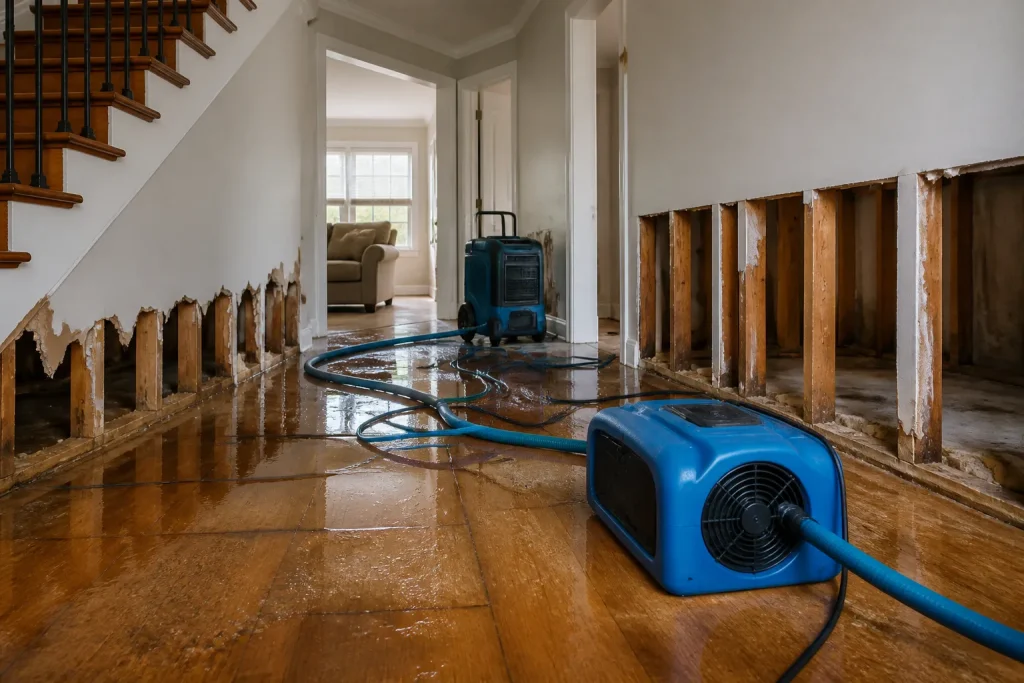
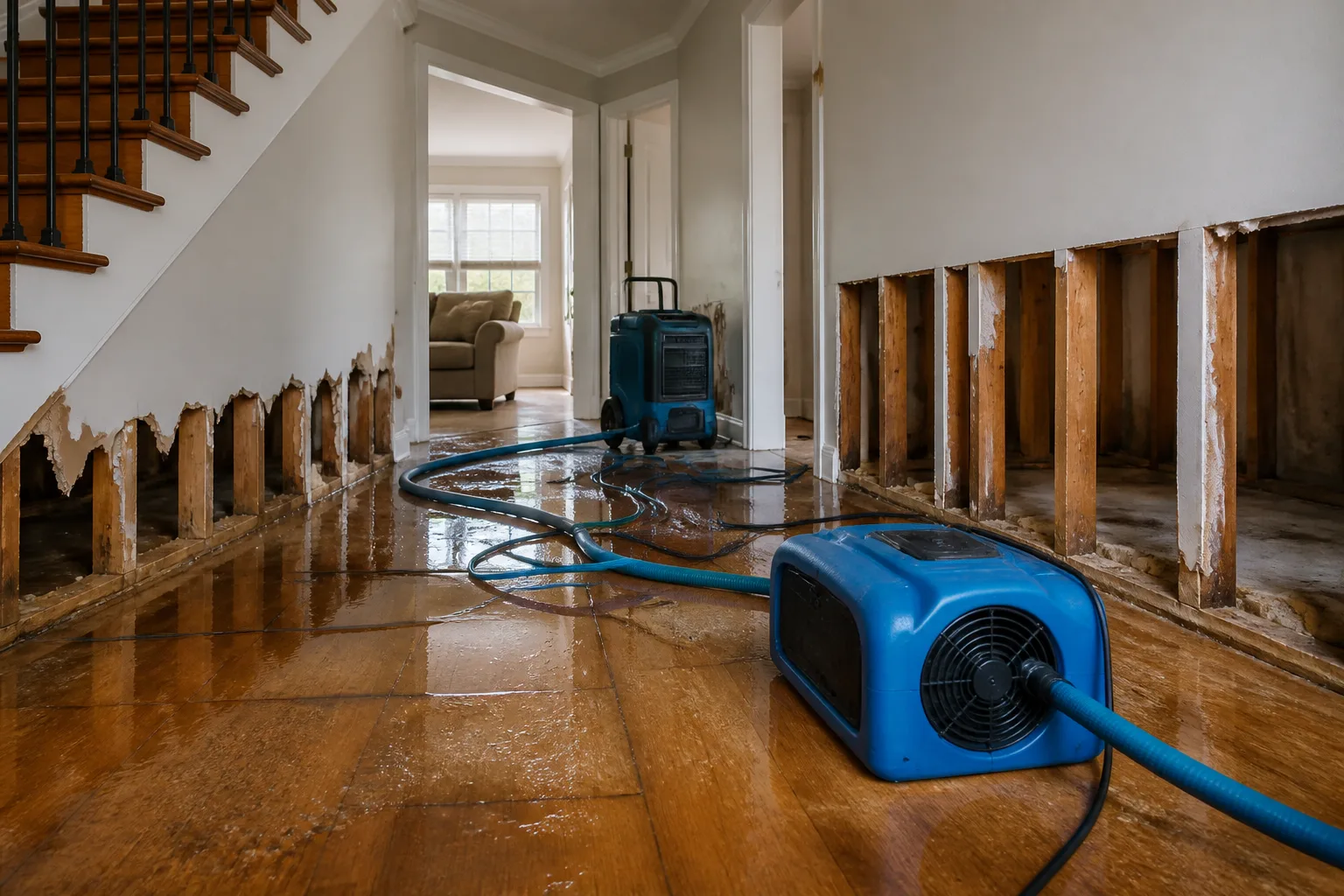
During extraction, the standard requires removing standing water using professional-grade equipment, not shop vacs. Floodline Restoration Co. runs home extraction trucks with Phoenix and XPOWER units that pull water at volumes a rental machine can’t touch. After extraction, the S500 requires mapping moisture migration, meaning technicians should place probes in floors, walls, and ceilings to find where water traveled, not just where it pooled. This moisture map becomes the baseline for everything that follows. In a balloon-frame house over on Elm Street, water that enters the basement can wick up wall cavities to the second floor. A certified crew accounts for that before drying even starts.
Drying follows established psychrometric principles: temperature, humidity, and airflow managed together. The standard requires daily moisture readings, not a once-a-week check. Dri-Eaz and B-Air equipment stays in place until the dry standard is hit, not until the machine rental period ends. Documentation means a log of every reading, every adjustment, every day. No log, no certified job.
Why Kearny’s Older Housing Stock Demands a By-the-Book Approach
Kearny was built before 1970 in large part, meaning balloon-frame construction with continuous wall cavities running from basement sill to attic. That construction style creates moisture pathways a modern platform-framed house simply doesn’t have. Water entering at the foundation can travel vertically through those cavities, hitting plaster keys and lath that hold moisture for weeks.
We’ve seen it repeatedly in Kearny neighborhoods like Arlington and the area around Kearny Avenue: a basement leak in a 1920s colonial that someone dried with box fans and called done. Six months later, the homeowner catches a musty smell. We open the wall and find the lath still reading 22% moisture at a height of four feet. The surface was dry. The structure wasn’t. That’s the exact scenario the RIA standards exist to prevent.
Older masonry foundations add another layer. Fieldstone and aging brick wick water laterally through mortar joints. A proper RIA process accounts for this with drying chambers and, where needed, Injectidry injection systems that force air into wall cavities. This is not extra equipment for show. It’s what the standard requires when a moisture map indicates water inside a wall assembly.
How to Read a Moisture Log
A moisture log is the single most important document in water damage restoration in Kearny. If a contractor cannot produce one, or produces one with a single reading per week, the job is not being performed to certified standards. Here’s what a professional log contains and what the numbers mean.
- Dry reference reading: A measurement taken from an unaffected area of the same material. For drywall in a Kearny home, this might be 8-10% moisture content. For framing lumber, 10-12%. This reading is the target.
- Daily readings: Each affected area gets measured every day with moisture meters. The log records the exact location, the material, and the percentage.
- Equipment adjustments: When readings plateau or the humidity doesn’t drop, the standard requires adjusting airflow, adding dehumidification capacity, or repositioning equipment. A competent log documents these changes.
- Dry standard confirmation: The job ends when affected materials measure within 2% of the dry reference reading, not when the equipment gets picked up or the invoice gets written.
Readings typically drop fast in the first 48 hours, then slow. A log that shows progress stalled for three consecutive days with no equipment adjustments is a red flag. In our experience, a Phoenix LGR dehumidifier sized correctly for a Kearny basement should pull moisture readings down steadily through day four or five, barring hidden pockets or foundation issues.
Ask for the log. Not a summary, not a verbal assurance. The log. A certified crew hands it over at the end of the job. We give every Kearny homeowner the complete moisture log along with our Water Damage Restoration in Kearny final documentation. It’s part of the file your insurance carrier receives for direct billing, and it’s your proof the job met the dry standard.
Questions to Ask Before Anyone Touches Your Floor Joists
A certified crew answers these without hesitation. A crew working off a sales script will struggle. Here are the questions that separate the two, based on what the RIA process demands in a pre-1920 balloon-frame house.
- “What dry reference reading are you using and where did you take it?” A certified technician can point to the unaffected area measured and the number it produced. If the answer is vague, that’s your signal.
- “How many moisture readings will you take per day, and will I see the log?” The standard requires daily readings. You should receive the log at completion, and you should be able to see it any time during the job.
- “What’s your plan for wall cavities in a balloon-frame structure?” This one eliminates most non-certified crews instantly. The correct answer involves cavity probing, possibly injection drying, and a detailed migration map. Wrong answer: “We’ll just open it up and take a look.”
- “Is your drying plan based on psychrometric calculations or a rule of thumb?” Certified crews compute the affected square footage, the class of water, and the drying chamber’s cubic feet, then match equipment accordingly. Rule-of-thumb crews guess.
- “Will you put the dry standard and a re-treatment guarantee in writing?” A legitimate operation does this without blinking. That guarantee tied to a specific moisture reading is the legal backbone of the entire job.
If a contractor in Kearny can’t answer all five, you are not hiring a certified restoration crew. You are paying someone to make the problem invisible for a few months. With a post-1970 house, you might get away with it. In a 1920s balloon-frame Kearny home, you will not.
Why a Written Guarantee Matters More Than a Verbal One
Verbal assurances have no force. A written guarantee tied to specific RIA and IICRC S500 compliance does. When a contractor hands you a document stating the dry standard was met as measured against a specified reference reading, and that document is backed by a company willing to return and re-dry if those readings fail, you have something enforceable.
We founded Floodline Restoration Co. in 2010 around a dispatch board, not a sales desk, with one guarantee we’ve never had to argue over: the 90-Day Done Right Promise, what we call the Keystone Standard. If it’s not done right, we make it right. In writing. No paperwork battles. That guarantee is our keystone, and the K.E.Y.S. code behind it – Krafted right, Every time, Your home first, Standing behind it – is the framework we train every technician under. When a Kearny homeowner calls us after another company’s work fails a moisture re-check eight weeks later, the verbal promise that crew made doesn’t do anything for them. We’ve pulled one out of a garage over near the Tappan Street area just last month where a previous “drying” left sill plates at 25% moisture. The homeowner had a text message from the prior contractor saying, “It’s dry, you’re good.” That text didn’t re-dry the framing. Our 90-Day Done Right Promise did it for free.
Kearny homeowners who’ve been through a botched job once understand this distinction better than anyone. A written guarantee tied to measurable, named standards is not a sales trick. It’s the only evidence that matters if the problem returns. When we finish a job, we hand over the moisture log and the written promise, and our direct insurance billing means no one is left carrying paperwork between Floodline and the carrier.
The Bottom Line
RIA certification and IICRC S500 compliance are not marketing language. They are a set of measurable procedures: moisture mapping before drying, daily documented readings, equipment sized to psychrometric calculations, and a written dry standard confirmed against a reference reading. In Kearny’s pre-1970 balloon-frame housing stock, skipping any of these steps means moisture stays where you can’t see it until it becomes mold, rot, or both. The questions above give you a way to verify credentials before a single floor joist gets touched. If you’re in Kearny and dealing with water damage, Floodline Restoration Co. offers free estimates and direct insurance billing. Call (551) 373-5246 and ask for the log. We’ll show you what a real one looks like.
Frequently Asked Questions
What does RIA certification actually mean for water damage restoration?
RIA certification means the restoration company follows the IICRC S500 standard for professional water damage restoration. That standard requires moisture mapping, daily documented readings, psychrometric-based drying plans, and confirmation that affected materials reach within 2% of a dry reference reading before the job is complete. A company without it may still dry your house, but you have no way to verify the job was done correctly without the log and the standard behind it.
How do I know if my Kearny home is actually dry after water damage?
Ask for the moisture log. A professional log shows daily readings for every affected area alongside the dry reference reading from an unaffected section of the same material. The job is done when affected materials measure within 2% of the reference. If you only get a verbal assurance or a single final reading, the dry standard has not been verified. For Mold Remediation in Kearny, that same log matters – mold returns when the moisture does.
Why do older Kearny homes need a different approach to water damage drying?
Pre-1970 Kearny homes often use balloon-frame construction, where wall cavities run continuously from foundation to attic. Water entering at the basement can wick upward through those cavities, saturating plaster, lath, and framing far from the original leak. A by-the-book RIA process accounts for this with cavity probing, moisture migration mapping, and often injection drying like the Injectidry systems we run. Standard surface drying misses what’s happening inside those walls.
Will my insurance cover water damage restoration in Kearny?
Most homeowner policies in New Jersey cover sudden and accidental water damage, such as a burst pipe or appliance failure. Gradual leaks and long-term seepage are often handled differently. Floodline Restoration Co. bills your carrier directly and coordinates with your adjuster using the documented moisture log as evidence of the work performed per certified standards, so you’re never playing messenger between us and the carrier. Call (551) 373-5246 and we’ll help you understand your policy before work begins.
Related services in Kearny: Mold Remediation in Kearny and Fire & Smoke Damage Restoration in Kearny.
Written by Curt Bowman, Owner at Floodline Restoration Co., serving Kearny since 2010.
Need Damage Restoration Help?
Call Floodline Restoration Co. - licensed & insured, here with fast after-hours help in Kearny.
(551) 373-5246