
Emergency Water Damage Restoration Near Me: What Kearny Homeowners Should Do First
If water is rising in your Kearny home right now, shut off the source first, then call (551) 373-5246. The first 60 minutes are the only window you control entirely - everything after that belongs to the contractor, the drying equipment, and the insurance adjuster. Here’s how to make those minutes count. If you’d rather not sort through this alone, call Floodline Restoration Co. and a live dispatcher answers at any hour.
Most homeowners call a restoration company before they’ve even found the shut-off valve. That’s backwards. And calling the wrong one in a panic is how people end up locked into a contract with a crew that hands the rebuild off to a subcontractor they’ve never met. We’ve walked into too many Kearny homes where that already happened.
The First 60 Minutes: A Sequence That Works
You don’t need to be a plumber to stop the bleeding. You need a sequence. Here’s the order we teach our own neighbors in Kearny:
- Stop the water at the source. If it’s a burst washing machine hose, turn the valve behind the machine. If it’s a water heater, there’s a shut-off on the cold water line above it. If you can’t identify the source or the valve is stuck, go straight to the main shut-off. In most Kearny homes, the main valve is in the basement near the front wall, often behind the water meter. Older homes on Kearny Avenue and the side streets off Belgrove Drive frequently have it in a crawl space near the foundation wall.
- Kill the electricity only if you can do it safely. If water has reached an outlet, a power strip, or the electrical panel, do not step into that water. Go to the breaker box and shut off the circuits for the affected rooms. If your panel is in a wet basement, call PSE&G and a restoration crew - not a DIY attempt. Standing water carrying current is how people get hurt. We treat every water event as an electrical event until proven otherwise.
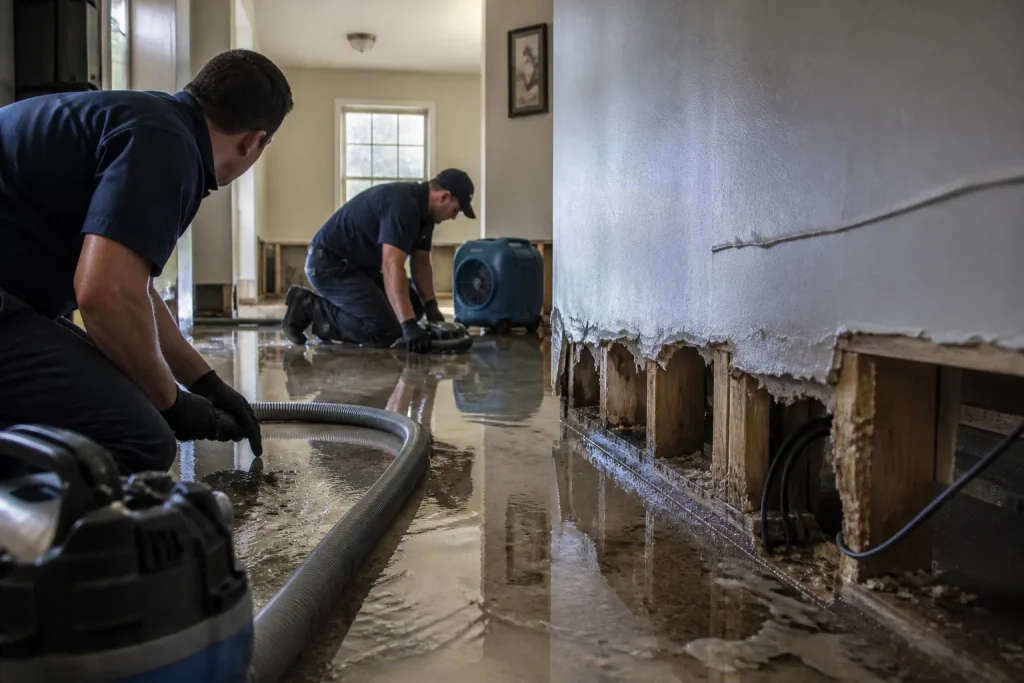
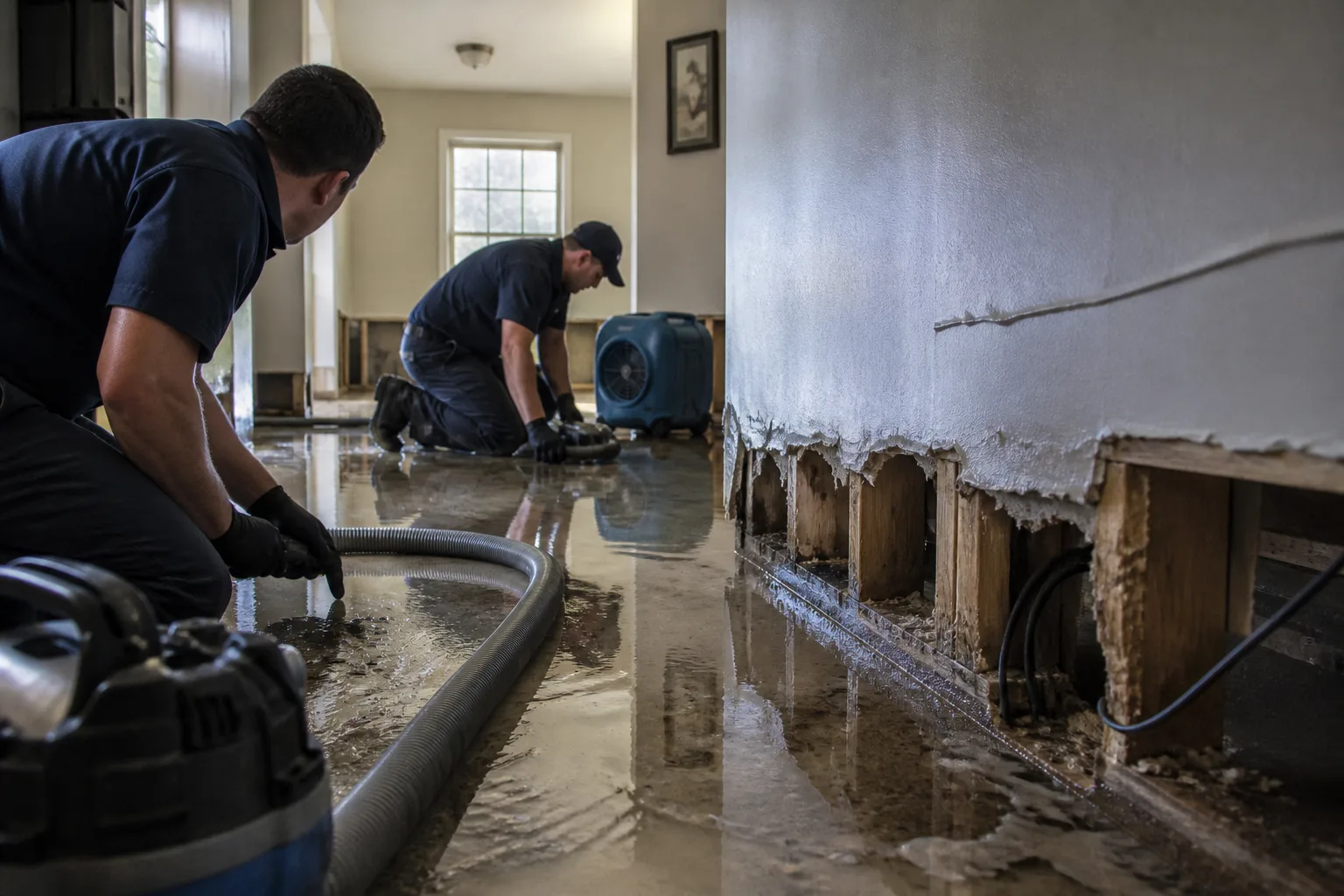
- Photograph everything before you move anything. Your phone camera is the single most valuable tool you own in the first hour. Shoot wide shots of the room, close-ups of the affected walls, and the water line on drywall and baseboards. That line - the floodline - is where we start. It tells us exactly how high the water wicked, and it’s evidence your insurance carrier will want.
- Move what you can, but not into a different room without checking. Wood furniture, shoes, cardboard boxes, and papers should come out of the water. But don’t drag a wet sofa across a dry hardwood floor - you’ll scar it. And don’t pile wet items on top of drywall in a closet, because you’re just moving the moisture problem somewhere darker.
One more thing that surprises people: you don’t need to know whether you have coverage to start mitigating. You need to stop the water. Delaying because you’re waiting for an adjuster to call back is how a $3,000 drying job becomes a $40,000 rebuild. In Kearny, where many houses share a common wall and finished basements sit below the water table, delay is the most expensive item on the invoice.
Why “Near Me” in Kearny Often Means a Dispatch Center in Another State
Here’s a hard truth about the emergency water damage restoration Kearny NJ searches you’ll run at 2 a.m. Many of the top results are not local companies at all. They’re national lead-generation operations that buy ad space, collect your call, and then sell the job to whoever will take it that night - sometimes a licensed local crew, sometimes not.
How do you spot them before you’ve committed?
- They can’t tell you who the technician will be. A real Kearny-based company knows its own crews. A broker has to make calls.
- They won’t give you a license number when you ask. You’re entitled to ask “What’s your NJ contractor’s license number?” before you agree to anything. If the person on the phone hesitates, that’s your answer.
- The price is firm before anyone has seen the job. A real restoration estimate requires a look at the water line, the flooring type, and the humidity reading. A flat quote over the phone means someone is selling a lead, not a solution.
- You’re asked to sign something before the crew arrives. That’s called a work authorization, and a broker may present it before you’ve even met the crew that’s supposedly working for you.
Floodline Restoration Co. has been on the Kearny map since 2010, and our dispatchers work from an office where the dispatch board hangs on the wall - not a call script in a cubicle in Phoenix. When you call (551) 373-5246 at two in the morning, a live person answers, and the crew that arrives is our crew. Background-checked, uniformed, and certified to IICRC, RIA, and IFA standards. Not a subcontractor we found on a marketplace app.
What to Say to Your Insurance Carrier in the First Call
The first call to your insurance carrier matters more than most people realize. The adjuster is listening for language that lets them limit the claim. Here’s how to protect yourself:
- Say: “We have water damage from a burst supply line. I’ve shut off the water. I need to know what my policy covers for emergency mitigation and drying. I have photos I can send.”
- Don’t say: “I left the water running for a while before I noticed.” That word - “left” - triggers a negligence review faster than anything. The water ran. You discovered it. That’s the honest framing, and it’s accurate.
- Don’t say: “It’s not that bad.” Ever. At hour two, you genuinely don’t know what’s happening inside the wall cavity. The moisture map tells the truth, and it hasn’t been drawn yet.
- Say: “I have a restoration company coming. Can you tell me your process for reviewing mitigation invoices, or do you work directly with them?”
This last question matters in Kearny because so many homeowners get stuck playing messenger between the insurance carrier and the restoration crew. You should not be a part-time claims adjuster while your home is drying. Floodline Restoration Co. bills carriers directly. We’ve done it hundreds of times. We know what an adjuster needs to see: the moisture log, the daily readings, the photo documentation. We hand it to your carrier and let you get back to your life.
How to Vet a Contractor in Under Five Minutes at 2 A.M.
You’re standing in two inches of water. The internet is full of ads. How do you choose quickly without choosing badly? Five checks, in order:
- Ask for the license number. In New Jersey, home improvement contractors and water damage restoration companies need to be registered and licensed. You can verify a license with the NJ Division of Consumer Affairs online in under a minute. Write it down. A company that hesitates to give it is a company to hang up on.
- Ask “Will the same crew that does the extraction also do the rebuild?” If the answer is “We’ll hand that off to our construction partner,” you just found a company that will leave you mid-job. At Floodline Restoration Co., Water Damage Restoration in Kearny means the same crew handles extraction, drying, and the rebuild that follows. No hand-off.
- Ask what equipment they’re putting in tonight. Listen for actual brand names. We run Dri-Eaz, Phoenix, and XPOWER dehumidifiers and air movers, plus Injectidry systems for wall cavities and under-cabinet drying. If the company can’t name their equipment, you’re hiring a marketing firm with a pickup truck.
- Call and see if a human answers. This sounds obvious, but at 2 a.m. most companies roll to voicemail. A live dispatcher means the company actually staffs nights. We do. Every night, 24/7.
- Ask about the guarantee before work starts. “What happens if it’s not dry in three months and mold shows up?” Listen carefully. A real company has a real answer in writing. Ours is the 90-Day Done Right Promise - we call it the Keystone Standard. If it’s not done right, we make it right. No paperwork battles, no arguing.
The One Written Document You Should Demand Before Equipment Enters Your Home
Before one dehumidifier crosses your threshold, request a written scope of work. Not an estimate. A scope. It should contain:
- A list of the rooms and surfaces affected, with moisture readings recorded before any equipment goes in.
- A drying plan that names the type and number of machines, where they’ll sit, and how many days they’ll run.
- A daily moisture log commitment - not “We’ll check when we can,” but “We’ll revisit daily until drying is complete, and we’ll give you the log.”
- A line-item price for every phase - extraction, equipment, monitoring, and any repairs required to return the home to its pre-loss condition.
- The name and license number of the company performing the work.
A written scope protects you from the two most common failures in this trade: scope creep and surprise charges. It’s the difference between a square deal and a guessing game. If a company won’t put it in writing before starting, that’s a company that plans to renegotiate after your walls are open. In Kearny, where so many homes share foundations with the neighbors and a bad drying job becomes a dispute that crosses property lines, a written scope is not a luxury. It’s the only sensible way to hire.
When Water Damage in Kearny Means More Than Drying
Not every water event ends with fans and a dehumidifier. If the water came from a sewer backup or sat for more than 24 hours, you’re no longer dealing with clean water. You’re dealing with contaminated water, and that changes everything. Our Mold Remediation in Kearny team works cases where homeowners thought a damp basement would “just air out.” It doesn’t. In Kearny’s humid summers, the window for mold growth is short - sometimes under 48 hours inside a wall cavity. The answer is never bleach. The answer is a moisture map, controlled drying, and a post-remediation test.
Same goes for fire-related water damage. When the fire department leaves, the water the hoses left behind is just as destructive as the smoke. That’s why we handle Fire & Smoke Damage Restoration in Kearny the same way: full-cycle, no mid-job handoff, with the same crew from the first extraction to the last finish nail.
And when the water came from a storm - remember the flash flooding along the Passaic River that made its way up toward Kearny’s low-lying streets - the damage isn’t limited to what you can see. Water moves through a home the way a person walks through a house: it follows the path of least resistance, which means under the baseboards, into the wall cavities, down the stairs, and into the finished basement. The line the water left is where we start. The moisture map tells us where it actually went.
We pulled one out of a split-level off Schuyler Avenue last spring where the owner had already called two companies. One never showed up. One showed up, took photos, and left without putting down a single mat. By the time we arrived, the drywall had wicked water 18 inches above the baseboard. The homeowner had done everything right - shut the valve, took photos, called his carrier - and the industry still failed him. That’s the kind of thing that keeps us from ever running a recording on our phone line.
The Bottom Line
Water damage in Kearny doesn’t wait, and neither should you. Shut off the water. Kill the power if it’s safe. Photograph everything. Get a written scope before any equipment goes in. Ask for the license number and the guarantee in writing. And if you want a company that answers the phone with a person at any hour, calls are answered live at Floodline Restoration Co. day and night. If you’re in Kearny and need help right now, call (551) 373-5246 for a free estimate. The first 60 minutes belong to you. The rest can belong to a crew that does it right.
Related services in Kearny: Water Damage Restoration in Kearny · Mold Remediation in Kearny · Fire & Smoke Damage Restoration in Kearny · Floodline Restoration Co. home
Frequently Asked Questions
Shut off the water at the source or the main valve, then kill power to any affected rooms if water has reached outlets or the panel. Photograph everything before moving anything, then call a restoration company. The first 60 minutes are the difference between a drying job and a rebuild. Call (551) 373-5246 and a live person answers day or night.
Same visit in most cases. Floodline Restoration Co. runs live dispatch around the clock, and a local crew reaches Kearny addresses quickly - not a truck dispatched from another county or another state. Most jobs have extraction running the same visit. Call (551) 373-5246 for a straight answer on timing.
Most homeowner’s policies cover sudden and accidental water damage from a burst pipe or supply-line failure, but not gradual leaks or neglect. Photograph the scene before anything moves, and don’t use language like “I left it running” when you call your carrier. Floodline Restoration Co. bills insurance carriers directly and documents every phase with photos and a daily moisture log. Call (551) 373-5246 and we’ll walk you through the first call.
Fans dry the surface. They don’t dry the wall cavity or the subfloor. In Kearny’s climate, hidden moisture becomes mold in under 48 hours in the summer. If you caught it immediately and it’s a small spill, dry it thoroughly and watch for odor. If water wicked into drywall, baseboards, or under flooring, you need professional extraction and controlled drying. Estimates are free - call (551) 373-5246.
Floodline Restoration Co. gives every customer a written guarantee: if the work isn’t done right, we make it right, for 90 days after completion. We call it the Keystone Standard. If mold shows up or the drying failed, you’re not fighting us over the phone - we’re back in the house fixing it. No paperwork battles, no arguing.
Written by Curt Bowman, Owner at Floodline Restoration Co., serving Kearny since 2010.
Need Damage Restoration Help?
Call Floodline Restoration Co. - licensed & insured, here with fast after-hours help in Kearny.
(551) 373-5246